

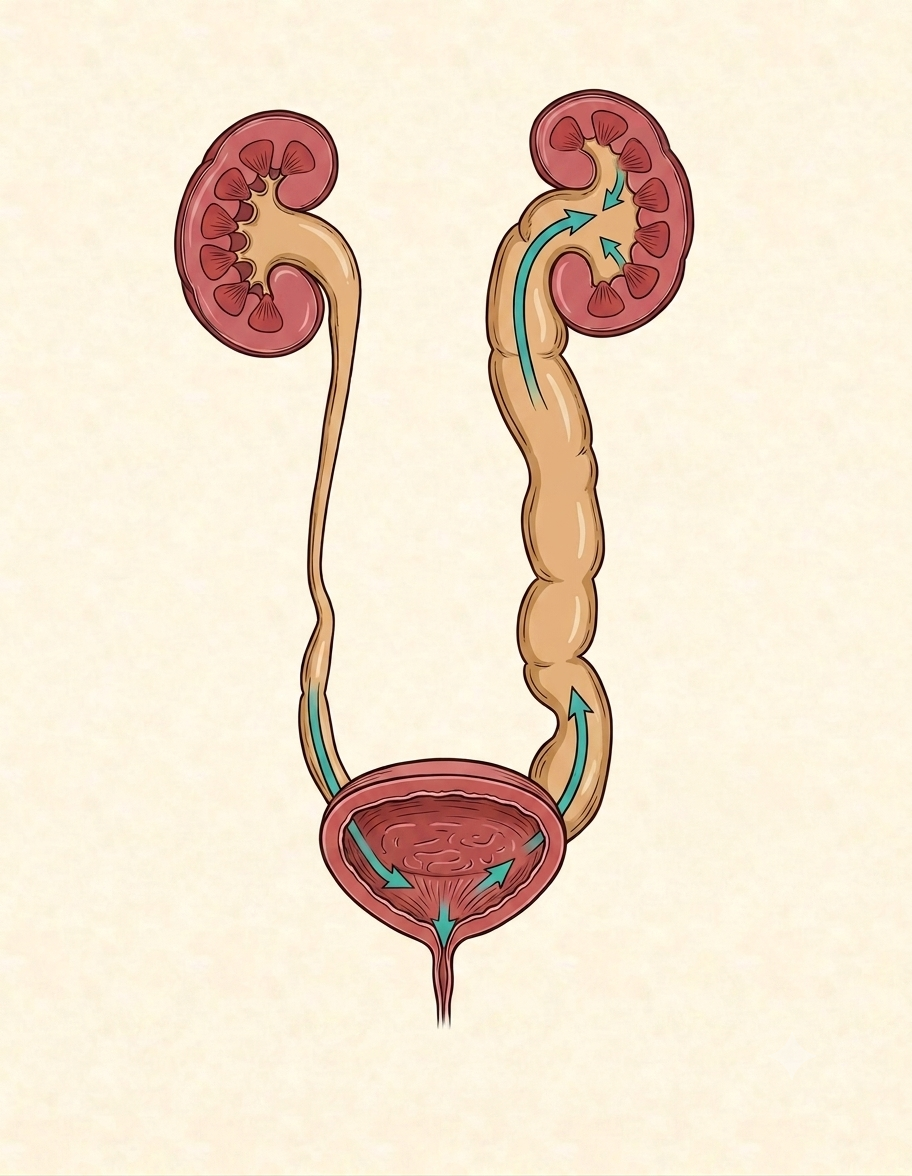
What causes VUR?
The most common cause is a congenital abnormality of the junction where the ureter enters the bladder. Less commonly, VUR develops secondary to increased bladder pressure, such as in children with neurogenic bladder dysfunction, posterior urethral valves, or significant voiding dysfunction.
What are the symptoms?
Many children have no symptoms for a long time. The most common signs include:
recurrent urinary tract infections (UTIs) associated with high fever;
abdominal or flank pain;
abnormalities in urine tests;
dilation of the ureter or renal pelvis detected on ultrasound.
Sometimes VUR is discovered incidentally during the evaluation of a urinary tract infection.
How is VUR diagnosed?
The gold standard for diagnosing VUR is voiding cystourethrography (VCUG), which determines the presence and grade of reflux.
Additional investigations include:
ultrasound examination of the kidneys and bladder;
urine analysis;
when indicated, DMSA renal scintigraphy to evaluate renal scarring and kidney function.
Is surgery always necessary?
No. Treatment depends on the child's age, the severity of reflux, the frequency of urinary tract infections, and the condition of the kidneys.
In many cases, management consists of:
regular follow-up;
prevention of urinary tract infections;
treatment of bladder and bowel dysfunction, including constipation.
Surgical treatment may be recommended for children with high-grade reflux, recurrent febrile UTIs, renal scarring, or failure of conservative management.
Modern treatment options
Current minimally invasive and effective treatment methods include:
endoscopic injection therapy, in which a bulking agent is injected beneath the ureteral orifice;
laparoscopic or open ureteral reimplantation for more complex cases.
The choice of treatment is individualized based on the child's clinical evaluation and imaging findings.
Prognosis
With timely diagnosis and appropriate treatment, most children achieve excellent outcomes. The main goals of treatment are to prevent recurrent infections, preserve kidney function, and ensure a good quality of life.
Important: If a child experiences recurrent urinary tract infections accompanied by high fever, vesicoureteral reflux should be excluded. Early diagnosis and appropriate management help prevent permanent kidney damage and serious complications.